Mission-centered. Drake is committed to creating an exceptional, learning-centered environment in which faculty and staff work in collaboration with students. We continuously reflect on the student learning produced by Drake students and take action to strengthen that learning. This inquiry starts by identifying specific learning outcomes that shape student learning across a Drake student’s curricular and co-curricular experience.
Student-focused. Students and their work provide the best evidence of learning at Drake. We use assessment information to reflect on how the structure of students’ learning experiences contributes to their achievement of intended learning outcomes. We approach evidence of student learning by focusing on what a student is able to produce. This approach engages faculty in the collection and analysis of data, and ensures that action to improve student learning begins and ends with the student in mind.
Faculty-driven. Faculty lead assessment, and the interpretation and analysis of assessment information relies on both faculty’s disciplinary expertise and first-hand experience in the classroom. We work hard to ensure that our assessment processes for both General Education and academic programs are streamlined and align naturally with departmental or programmatic processes.
Learning Outcomes
Learning outcomes describe the knowledge, skills, and abilities that students should possess as a result of their Drake experience.
The learning outcomes below help faculty shape student learning across the Drake experience.
More Information
Faculty developed general education outcomes that fall under Drake’s Areas of Inquiry system. This system is designed to provide students with a solid introduction to a variety of intellectual fields and a diversity of learning experiences.
General Education Outcomes
Under each college and school at Drake University, each academic degree program has identified learning outcomes to reflect the program-level learning that faculty intend each student for each student upon graduation.
Academic Program Outcomes
General Education Outcomes
Faculty developed general education outcomes that fall under Drake’s AOI system. This system is designed to provide students with a solid introduction to a variety of intellectual fields and a diversity of learning experiences.
- Identify the characteristics of different artistic styles - visual, musical, or theatrical - and the factors that contributed to their establishment.
- Articulate the role played by an art form - visual, musical, or theatrical - in the development of culture(s) or as a distinctive expression of human identity and creativity.
- Articulate an analytical and reasoned understanding of a specific visual, musical, or theatrical art form and communicate this understanding in an appropriate form, whether oral or written or through the artistic medium itself.
- Demonstrate an understanding of the nature of the visual, musical, or theatrical arts through the application of or engagement with an art form.
- Clearly define a question or problem.
- Gather information that is relevant to that problem.
- Rigorously identify assumptions and preconceptions, including their own, that influence analysis of that problem.
- Learn to evaluate the mix of diverse values and interests that influence democratic decision-making.
- Establish skills, knowledge, or dispositions that lead them to be active stewards for the common good.
- Critically reflect on the social, economic, or political issues that they will face as citizens.
- Learn democratic practices or public engagement through participatory activities organized in the classroom and/or in the community
- Demonstrate an understanding of the interplay of the fundamental historical forces (political, social, economic, cultural, scientific, and/or technological) that have shaped the contemporary world.
- Describe the historical processes that have contributed significantly to global change.
- Articulate an understanding of the histories of societies and cultures necessary to participate in an analysis of critical civic and global issues.
- Demonstrate critical reasoning skills necessary to analyze the lived realities of power and wealth differentials between industrialized and developing areas of the world.
- Reflect upon the nature of history itself as a product influenced by a nexus of forces, interests, and understandings, and on their own place within that historical context.
- Navigate and integrate scholarly resources into their research and reflection.
- Articulate the social and ethical implications of information use and misuse.
- Evaluate information resources and identify quality resources relevant to the problem or issue investigated.
- Select and employ the appropriate method and data for disciplinary research, problem-based learning, experiential-based research, and/or reflective/integrative coursework.
- Articulate the basic implications of information use and misuse related to issues of academic honesty and plagiarism and pursue their educational goals with a high level of academic integrity.
- Interpret intercultural issues from diverse perspectives and reflect critically on the self and others to demonstrate an understanding of the complexity of cultural issues in local, national, and global contexts.
- Explore the elements that create diversity and explain their impact on the development of a culture or interaction between cultures in the context of complex systems of exclusion and privilege.
- Identify and analyze how institutions adjust in response to struggles among members of diverse societies and how they address their needs.
- Reflect on their own cultural biases and consider the skills, knowledge, collective efforts necessary to help foster inter-cultural communication, respect, and understanding.
- Apply the methods of science for the generation, collection, assessment, and interpretation of scientific data and/or phenomena.
- Use scientific methods and ways of thinking to solve problems.
- Describe scientific theories on cognitive and behavioral, intellectual, or physical development.
- Articulate the interrelationship of the development of human societies with the natural world around them.
- Articulate the relevance of science to the global community in order to serve as active stewards for the natural environment.
- Analyze and present solutions to problems using symbols and components from mathematical languages and their underlying principles.
- Identify and execute appropriate mathematical operations for a given question.
- Evaluate claims based upon mathematical arguments.
- Recognize and reflect critically on ethical issues.
- Identify values that underlie human activities.
- Articulate ethical issues that arise in their professional or civic life.
- Articulate relevant ethical issues and apply them in developing solutions for critical problems and questions.
- Articulate a reasoned vision of their own values or core beliefs.
- Read with discrimination and understanding.
- Shape their writing according to subject, purpose, medium, context and intended audience.
Academic Program Outcomes
Academic degree programs identify the specific knowledge, skills, and abilities that students should have when they complete their program based upon faculty expertise and the standards/competencies common to the field or through each program’s accrediting body. If a program’s outcomes are incorrectly stated, please contact judith.jones@drake.edu.
College of Arts & Sciences
- Characterization
- Emotion
- Human communication
- Technical competence
- Theory: students will learn to recognize, critically engage with, and productively use key sociological concepts and perspectives.
- Research design: students will learn how to ask critical questions about the social world and discover evidence to answer them.
- Interdisciplinary knowledge building: students will learn to create constructive dialogues between sociological knowledge and other approaches to social and cultural analysis.
- Critical and reflexive understanding: students will learn to locate and examine their experiences and beliefs – as well as larger public concerns – in the context of prevailing cultural discourses, social institutions, and power arrangements.
- Performance
- Musicianship Skills and Analysis
- Composition/Improvisation
- History and Repertory
- Synthesis
- Evaluate works of art critically, using professional art terminology, and communicate this analysis in both written and verbal form.
- Use disciplinary methods to understand artistic productions from a broad range of periods and cultures.
- Understand the relationship between artworks and their social contexts as well as their own historical position in relation to visual art of different periods.
- Conduct and communicate an independent art historical inquiry that contributes to the field.
- Energy – Energy is Required by and Transformed in Biological System
- The nature of biological energy
- Catalysis
- Energetic coupling of chemical processes in metabolic pathways
- Structure & Function: Macromolecular Structure Determines Function and Regulation
- Biological macromolecules are large and complex
- Structure is determined by several factors
- Structure and function are related
- Macromolecular interactions
- Macromolecular Structure is dynamic
- The biological activity of macromolecules is often regulated
- The structure (and hence function) of macromolecules is governed by foundational principles of chemistry and physics
- A variety of experimental and computational approaches can be used to observe and quantitatively measure the structure, dynamic and function of biological macromolecules
- Information Storage: Information Storage and Flow are Dynamic and Interactive
- The genome
- Information in the gene: nucleotide sequence to biological function
- Genome transmission from one generation to the next
- Genome maintenance
- Skills: Discovery Requires Objective Measurement, Quantitative Analysis & Clear Communication
- Process of science
- Accessing, comprehending and communicating science
- Community of practice
- Evolution
- The significance of evolution
- Mechanisms of evolution
- Natural selection is a key evolutionary mechanism
- Homeostasis
- Biological need for homeostasis
- Link steady state processes and homeostasis
- Quantifying homeostasis
- Control mechanisms
- Cellular and organismal homeostasis
- Other
- Communication
- Teamwork
- Labs
- Safety
- Responsible conduct of research
- Solve Biological Problems: Apply knowledge of scientific methods, quantitative reasoning, and experimental design to solve biological problems.
- Design Experiments: Develop well-reasoned experimental hypotheses, design experiments, and define experimental predictions by which to test them.
- Collect/Interpret Data: Collect, organize, analyze, and interpret quantitative and qualitative data and incorporate them into the broader context of biological knowledge.
- Demonstrate Knowledge: Demonstrate a breadth of knowledge in biology, with a deeper understanding in specific areas of interest.
- Communicate Scientific Information: Communicate scientific information clearly and explicitly, both orally and in writing, to those in and outside the discipline, following conventional scientific formats.
- Do Scientific Research: Engage in scientific research, individually and/or in groups, and present the results of the research to peers and colleagues.
- Use Primary Literature: Demonstrate the ability to locate, interpret, and apply the primary literature of biology.
- Visualize 1: Visualize molecules, atoms, macromolecules, biomolecules and ions at an atomic level as demonstrated by their ability to draw “cartoons” and write descriptions that accurately reflect our current understanding of such systems
- Visualize 2: Visualize chemical and biochemical reactions and process at a molecular level as demonstrated by their ability to draw “cartoons” and write descriptions that accurately reflect our current understanding of such systems
- Calculate: Make the calculations required to predict the behavior of chemical and biochemical systems and to conduct chemical research and testing (e.g., dilutions, pH, equilibria, thermodynamics, etc.)
- Experiment 1: Carefully design, using controls, blanks, and standards, scientific experiments to prove/disprove hypothesis or to test ideas as demonstrated by their planning undergraduate research and by their writing of a novel research proposal that includes such techniques (junior seminar).
- Experiment 2: Execute their carefully designed experiments as demonstrated by their work in undergraduate research and in various laboratory courses.
- Experiment 3: Conduct and use proper laboratory manipulations required for research and laboratory work (syntheses, column chromatography, dilutions, pH measurements, pipetting, weighing, instrumental techniques).
- Experiment 4: Implement routine safety practices encountered in laboratory work as demonstrated by their undergraduate research and laboratories associated with courses and by their passing a safety test early in their seminar sequence (e.g., goggles, clothing, explosive potentials, peroxides, labeling, waste disposal, MSDS, etc.)
- Experiment 5: Predict and execute successful synthetic routes to new molecules as demonstrated by an organic chemistry laboratory practical exam.
- Present 1: Articulate a research project (conducted by the student or selected from the literature) to peer audiences and to professional audiences (e.g. at professional meetings)
- Present 2: Maintain professional laboratory notebooks and research reports (publication style)
- Present 3: Participate in discussions of research topics presented by internal and external speakers.
- Present 4: Write essays examining chemical processes and associated issues.
- Reflect 1: Critically read and understand journal articles as demonstrated by their written expositions on journal articles in courses throughout the curriculum. Write essays examining chemical processes and associated issues.
- Reflect 2: Articulate the impact and relation of the molecular sciences to society as demonstrated by their participation in seminar discussions about such topics centered around readings and outside speakers who address such topics (e.g., law, environment, drug companies, funding agencies, etc.)
- Reflect 3: Articulate the range of fields in which chemists are employed through their study in individual courses as well as through seminar discussions and outside speakers focused on careers in the molecular science (e.g., NASA, drug companies, P&G, 3M, EPS, NIST, universities, Monsanto, Pioneer Hybrid, Des Moines Water Works, medical testing, etc.)
- Ethics in chemistry: Students should be trained in the responsible treatment of data, proper citation of other’s work, and the standards related to plagiarism and the publication of scientific results. The curriculum should expose students to the role of chemistry in contemporary societal and global issues, including areas such as sustainability and green chemistry.
- Explain or describe how a computer works, including the software and hardware interface from a high-level language all the way to the hardware.
- Be able to read, comprehend technical information and effectively communicate technical details to others.
- Be able to demonstrate good programming techniques including abstraction (objects, functions, procedures, etc.) and commenting/documentation.
- Be able to solve problems using appropriate algorithms and data structures.
- Discuss the correctness and performance (algorithmic time/space analysis, big O, evidence of testing, etc. as appropriate).
- Given a data analytics problem, students will identify subproblems necessary to address the main problem, collect relevant data, and effectively communicate results as appropriate for the audience.
- Students will be able to visualize data, implement appropriate transformations and models, and evaluate the results using suitable metrics.
- Students will be able to write queries to ask complicated questions of a database and solve problems that utilizes distributed computing involving a large data set.
General Education Assessment
Drake’s general education curriculum is represented by the Drake Curriculum. The Drake Curriculum provides students with a meaningful liberal arts education and ensures students gain the breadth of knowledge and skills necessary.
The bulk of the Drake Curriculum is centered in the Areas of Inquiry (AOI). These 10 AOIs provide students with a solid introduction to a variety of intellectual fields and a diversity of learning experiences. Because the general education curriculum is owned by faculty, the Drake Curriculum Analysis Committee (DCAC) of the Faculty Senate oversees assessment of the Drake Curriculum, in particular the AOIs.
More Information
Faculty developed general education outcomes that fall under Drake’s AOI system. This system is designed to provide students with a solid introduction to a variety of intellectual fields and a diversity of learning experiences.
General Education Outcomes (AOIs)
To assess the AOI outcomes, AOI faculty have developed rubrics that describe the standards of performance for each AOI outcome. These rubrics explicitly differentiate student performance across four levels: (1) Unsatisfactory, (2) Marginal, (3) Satisfactory, (4) Excellent.
Artistic Experience
Critical Thinking
Engaged Citizen
Global & Cultural Understanding
Information Literacy
Quantitative Literacy
Scientific Literacy
Written Communication
DCAC produces regular reports on student learning in each AOI as a result of the quantitative and qualitative feedback and analysis of faculty, staff, and students.
Artistic Experience
Critical Thinking
Global & Cultural Understanding
Information Literacy
Quantitative Literacy
Scientific Literacy
Written Communications
DCAC Historical Foundations Report
The Longitudinal Panel Study examines students’ perceived intellectual growth over time by comparing students’ self-reported skill on a set of learning outcomes. Students are first assessed at first-year orientation and then assessed in March of anywhere from their first to fourth year.
2011-14 Longitudinal Panel Study
2013-17 Longitudinal Panel Study
2013-18 Longitudinal Panel Study
DCAC works towards a cycle of assessing the 10 AOIs within a student’s typical 4-year educational experience. AOI Faculty are heavily involved in the general education process by helping to develop and review the AOI rubrics, by rating and reviewing samples of student work, and by participating in an in-depth discussion of student learning within the AOI.
AOI Assessment Cycle & Process
Program Assessment
As goal-oriented academic programs, Drake academic programs identify the skills and abilities they expect students to possess when they graduate, and regularly review and reflect upon students’ ability to achieve these outcomes.
More Information
What do you mean by assessment? How do I assess student learning? What exactly do you want me to do?
When we talk about assessment at Drake, we refer to intentional and critical reflection on student learning through a program lens. This is a four-step process: (1) Learning Outcomes, (2) Evidence, (3) Findings, and (4) Action. Steps 1 and 2 are part of your Assessment Plan, and steps 3 and 4 are part of your Assessment Report.
At Drake, high quality assessment satisfies six criteria:
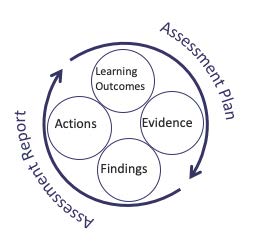 Assessment Plans should:
- Identify outcome(s) of focus
- Gather evidence that addresses outcome(s)
- Indicate when faculty will meet to reflect on evidence
Assessment Reports should:
- Analyze findings
- Develop a plan of action
- Implement the plan and report on the status
The program assessment process is owned by each individual college/school and the respective Associate Deans and Department Chair or Program Lead.
Assessment Criteria Guide
Assessment Quick Start Guide
What have my peers at Drake set as their learning outcomes? What strategies have worked for my colleagues across campus? How are the other academic programs at Drake regularly reflecting on student learning?
You can learn a lot about assessment by reviewing the work of your peers. Academic degree programs identify the specific knowledge, skills, and abilities that students should have when they complete their program.
Drake Student Learning Outcomes
Programs submit annual review and reflection on student learning to their Dean/Associate Dean. Here are some examples of how your colleagues are doing and using assessment:
- Guided Inquiry The History program used Guided Inquiry Protocol to have an intentional conversation about its learning outcomes centered on specific samples of student work from the capstone.
- Embedded Assessment The Data Analytics program uses specific assignment embedded within the curriculum as evidence of student’s achievement of learning outcomes.
- Use of Rubrics The MBA program uses rubrics to identify target levels of performance for their students and to diagnose why students might perform below proficiency.
- Closing the Loop The STEM Education program identifies program actions to improve student learning that address the specific gaps that the program identified.
17-18 Program Assessment Reports
18-19 Program Assessment Reports
Where does this all live? Can I review other programs’ reports?
All Drake faculty and staff have access to review and submit assessment information for their program. This occurs on a cycle decided by your college/school.
Assessment Sharepoint
- Collaborative Guided Inquiry The Guided Inquiry Protocol is an assessment framework that provides opportunity for faculty to discuss student work in an intentional way centered around learning outcomes.
- Curriculum Mapping A curriculum map allows a program to visually represent and align the program’s student learning outcomes to the program’s course progression, and allows the program to see how a student’s skills and abilities might progressively accumulate throughout the curriculum.
- Understanding by Design/Backward Design The Understanding by Design (UbD®) framework was created by Grant Wiggins and Jay McTighe to guide faculty to develop and implement a curriculum built around learning outcomes.
- Co-curricular Programs Assessment Worksheet The Council on Leadership Development developed an assessment worksheet to help co-curricular programs walk through how to assess one of their program’s learning outcomes.
Course Assessment
Faculty assess their courses on a daily basis. You do it when after each course you teach, you ask yourself, “How did that go?” Drake OIRA offers you a few dedicated resources as well as support from our office and the Center for Teaching Excellence.
More Information
Classroom Assessment Techniques. OIRA holds an annual workshop for new faculty on some formative classroom assessment techniques that can help faculty gain useful feedback to make changes in their courses.
Designing Purposeful and Integrative Learning. This assignment design worksheet helps faculty design purposeful and integrative learning experiences that are connected to learning outcomes.
Group Instructional Feedback Technique Focus Groups. Drake offers faculty an opportunity to focus group their course(s) to either gather information on program-level learning outcomes, or as a course-level formative assessment of teaching and learning. You may reach out to the Center for Teaching Excellence for consultation.
Scholarship of Teaching and Learning (SoTL) is the systematic inquiry into student learning. If you have ever asked yourself, “Why did that assignment work so well?” then you might have the basis for a SoTL project.
SoTL Worksheets General Every May, Drake runs SoTL workshops that help faculty identify and refine a research question, develop a research plan, and identify necessary resources.
SoTL Proposal 2020-21. Faculty may submit their project proposals for guidance throughout the year, as well as a small project stipend.