Middleton Center for Children's Rights
The Joan and Lyle Middleton Center for Children's Rights works to advance children's rights and improve the child welfare system and juvenile justice systems.
Middleton Center for Children's Rights
Drake's Middleton Center for Children's Rights has four components:
Children's Rights Clinic
Under faculty supervision, Drake Law students in the clinic represent children in juvenile court and special education matters and engage in community education and systemic reform projects.
Training
The Center provides training to lawyers, judges, social workers, educators, and youth on laws, legislation, and policies impacting children, as well as guidance on best practices when working with young people and their families.
Public Information
The Center creates, collects and disseminates information regarding the juvenile court system and the rights of children.
Public Policy Information
The Center works to foster systemic reform of the child welfare and juvenile justice systems through legislative advocacy, court and administrative reform efforts, community building, and leadership in local and national advocacy campaigns.
Learn more about the Middleton Center for Children's Rights:
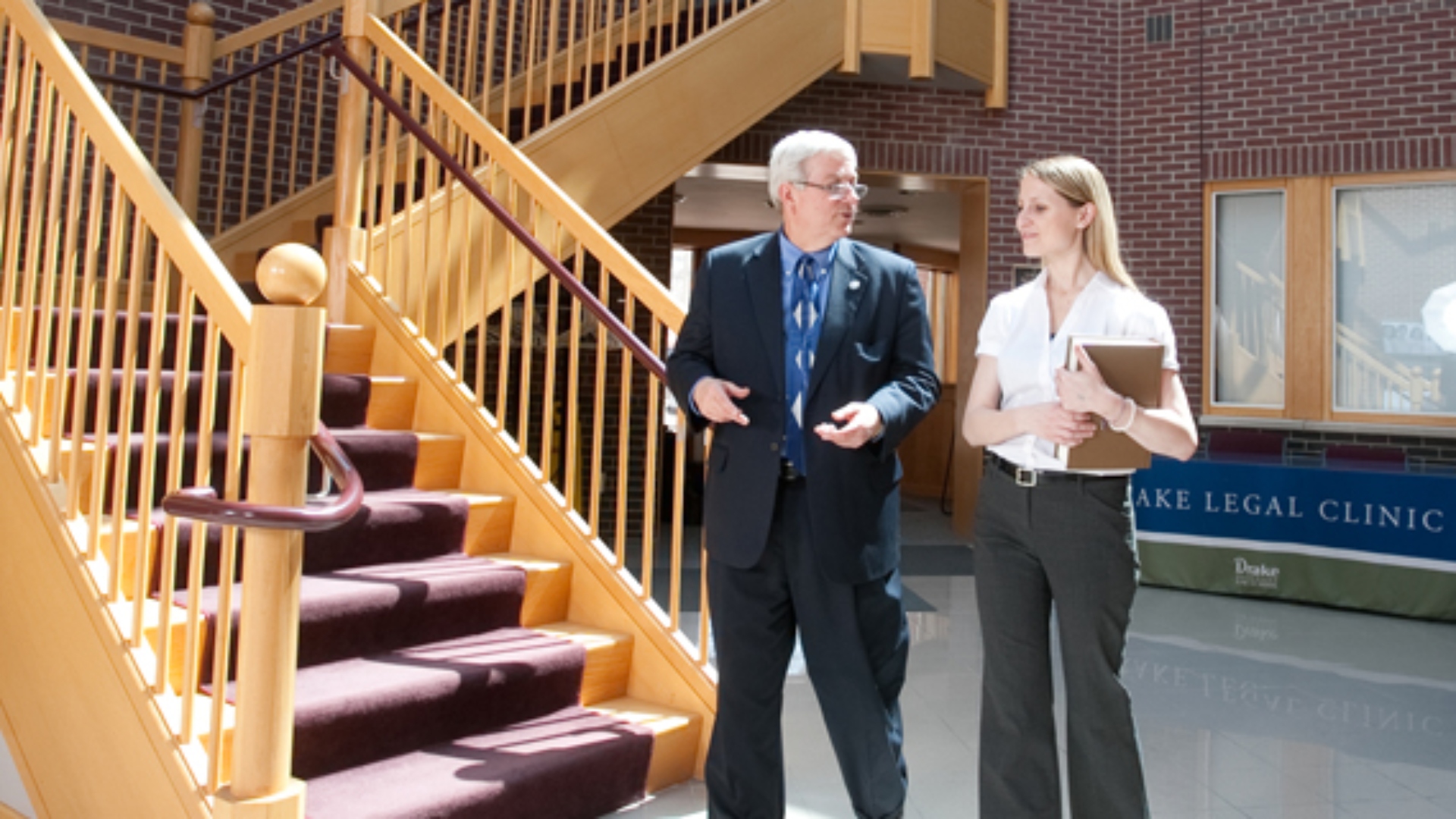
Students in the Middleton Center for Children's Rights explore children's rights issues and learn about the workings of juvenile court.
Curriculum
Drake Law School offers courses such as Children and the Law and Family Law, in addition to the Children's Rights Clinic.
Children's Rights Clinic
The Children's Rights Clinic furthers the training and public service goals of the Middleton Center for Children's Rights.
Through the clinic, Drake law students engage in children’s rights advocacy, including direct representation of children in administrative, school disciplinary, and juvenile court proceedings. Students also work to improve outcomes for children through advocacy efforts and community education projects.
Internships
Law students have opportunities for internships through Juvenile Law or the Middleton Center for Children's Rights.
The Juvenile Law internship places students in a wide array of legal settings, including the offices of the Attorney General, Public Defender, and County Attorney, the Department of Human Services, the Youth Law Center, or other agencies involved in juvenile justice. Interns have also served as clerks to juvenile court judges.
Interns in the Middleton Center for Children's Rights work on a variety of projects geared towards community needs. Projects may include research and writing on juvenile law, production of educational materials, work on the center's website, and more.
Policy
Students have opportunities to research children's rights issues and draft legislation and accompanying documents.
The center then works with Drake's Legislative Practice Center to submit the legislation to a licensed lobbyist board member to pass the legislation.
Students can sign up for extra credit to work with the lobbyist.
Resources for Caretakers
- Custodian Guide to Parent-Child Interactions in Iowa Prisons (pdf)
- Parent/Family Incarceration Resources for Children - Sesame Street Little Children, Big Challenges
- Kids with Incarcerated Parents - Julie Poehlmann-Tynan, PhD
- Visiting an Inmate in Iowa - Iowa Department of Corrections
Resources for Incarcerated Parents
- Parent Guide to Successful Parent-Child Interactions in Iowa Prisons (pdf)
- Handbook on Juvenile Court for Parents (pdf) - Iowa Judicial Branch
- Evelyn K. Davis Center for Working Families
- Parenting Inside Out
- Iowa Courthouse Directory
- Navigating Reentry
Resources for Parent Attorneys
- Due Process - In Re. M.D. (Nov.30, 2018)
- Visitation - In Re L.M. (Dec. 8, 2017)
- Iowa Appellate Incarcerated Parent Case Law Update (pdf)
- Incarerated Parents Project - Washington Defender Association
- Attorney Guide to Representing Incarcerated Parents (pdf)
Resources for Child Welfare Professionals
- "A Shared Sentence: The Devastating Toll of Parental Incarceration on Kids, Families and Communities" - Annie E. Casey Foundation
Tools for Iowa Social Workers
- Social Worker Guide to Evaluating Parent-Child Prison Interactions (pdf)
- DHS-FSRP Application Checklist (pdf)
- Prison Visitation Order (pdf)
- Iowa Dept. of Corrections Visitor Application (pdf)
Resources for Transnational Families Separated by Deportation/Detainment
Online Resources
Coalition for Family and Children's Services in Iowa – Works to influence and shape policy and practice for the betterment of Iowa children and families and the organizations that serve them
ABA Center on Children and the Law – Provides information on child law practice, including foster care/adoption, child protection, and child custody
Best Practices in Juvenile Law: Looking at the Evidence Base – Research-based guide on best interventions for clients.
First Star – Improves the lives of America’s abused and neglected children by strengthening their rights, illuminating systemic failures, and igniting necessary reforms.
Models for Change – Collaborates with selected states to advance juvenile justice reforms that effectively hold young people accountable for their actions, provide for their rehabilitation, protect them from harm, increase their life chances, and manage the risk they pose to themselves and to public safety.
The Gault Center – Provides support to public defenders, appointed counsel, law school clinical programs, and non-profit law centers to ensure quality representation. The center offers a wide range of integrated services to juvenile defenders, including training, technical assistance, advocacy, networking, collaboration, and capacity building.
Prevent Child Abuse America – Provides national and state statistics on abuse.
Rand Corporation – Research on areas such as child health and the role of the family unit, neighborhoods, and community influence on child well-being.
U.S. Department of Justice Office of Juvenile Justice and Delinquency Prevention – Provides national leadership and resources to prevent and respond to juvenile delinquency and victimization. The organization supports states and communities in their efforts to develop and implement effective prevention and intervention programs.
Legal Resources
Cases
United States Supreme Court Rulings
FindLaw: United States Supreme Court
Eighth Circuit Court of Appeals Cases and Resources
Federal District Court, Northern District of Iowa
Federal District Court, Southern District of Iowa
Iowa Supreme Court Opinions
Rules
United States Supreme Court Rules
Federal Rules of Civil Procedure
Federal Rules of Evidence
Iowa Civil Rights Commission Rules
Websites
ABA Criminal Justice Section
American Civil Liberties Union
Bureau of Justice Statistics
Federal Bureau of Prisons
Identity Authentication (LexisNexis)
Iowa Bar Association
Law Firm Directory (Martindale.com)
Lawyer Directory (Lawyers.com)
Legal Research (LexisNexis)
National Association of Criminal Defense Lawyers
National Legal Aid and Defender Association
Traffic Violations (Lawyers.com)
Government
Iowa Judicial Branch
Iowa State Government
Office of the Iowa Attorney General
Office of the Iowa Secretary of State
U.S. Census Bureau
U.S. Department of Justice – Office of Justice Programs
U.S. Department of Labor
Social Work Resources
Social Work Terminology
NASW – National Organization of Social Workers
DHS – Iowa Department of Human Services
DHS Worker – Social worker employed by the state to manage the case.
CPA – Child Protective Assessment
CPS – Child Protective Services
CPA – Child Protective Assessment
CASA – Court Appointed Special Advocate
JCO – Juvenile Court Officer
CINA – Child in Need of Assistance
FINA – Family in Need of Assistance
DCAT – Decategorization Team (special funding source within DHS to assist children)
Service Providers
OP – Orchard Place
CFI – Children and Families of Iowa
LSS – Lutheran Social Services
PCYS – Polk County Youth Shelter
IHYC – Iowa Homeless Youth Centers
Access Center – Iowa Lutheran Hospital's Children's Behavioral Health Services
EFR – Employee and Family Resources
CGC – Counseling for Growth and Change
Mercy – Mercy Franklin Center (Short-term hospitalization, day treatment, in-home services, counseling services)
Types of Services
Therapy Services – Individual therapy is often done by a LISW (Licensed Social Worker), psychologist, or psychiatrist in a professional office setting.
Psychosocial evaluation – Professional testing and evaluation done by a LISW or psychologist to make recommendations to the court about parenting ability and mental health status.
In-home Counseling – Counseling in the family's home, the service is child-focused.
Family Preservation Services – Short, intense services usually lasting 30-45 days.
Independent Living – Apartment-based living for children who are at least 16½ years of age.
Day Treatment – Treatment for a child who remains in the home but needs structure after school.
Tracking and Monitoring – Most often, when a delinquent child has to report to an adult as ordered by the court.
Residential Treatment – Long-term (3-9 months) treatment where the child lives at the facility.
PMIC – Second-highest level of treatment.
Hospitalization – Highest level of treatment. Often long-term and referred to as an MHI.
Additional Information
- A LISW is a social worker licensed by the state who has a master's degree and two years of experience.
- A child psychologist can do therapy and testing.
- A child psychiatrist is most often used for medication and consultation in a residential and hospital setting.
- Often, multiple social workers are on each case (i.e., school social workers, agency social workers, DHS social workers).
Brent Pattinson
Director of the Joan and Lyle Middleton Center for Children's Rights; Professor of Law
Legal Clinic
Law School
Phone: 515-271-1810
Email: brent.pattinson@drake.edu
Office: Drake Legal Clinic

Nickole Miller
Director of the Joan and Lyle Middleton Center for Children's Rights; Associate Professor of Law
Legal Clinic
Law School
Phone: 515-271-1809
Email: nickole.miller@drake.edu
Office: Drake Legal Clinic

Suzan Pritchett
Director of Clinical and Experiential Education; Professor of Law
Legal Clinic
Law School
Phone: 515-271-3391
Email: suzan.pritchett@drake.edu
Office: Drake Legal Clinic