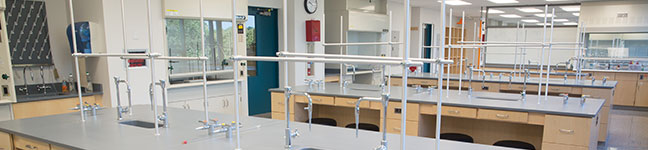
The Chemistry Department houses approximately $1 million of research grade, state-of-the art instrumentation dedicated to both teaching and research endeavors.
Students get hands-on experience with this instrumentation and become very proficient as they get involved with their research projects with faculty members from the department during their time at Drake.
Some instruments have been acquired through external grants submitted by faculty members from the department and some through endowment funds awarded from The Kresge Foundation.
Places to Study, Learn and Engage in Research
Biochemistry Laboratory
The Biochemistry Laboratory was recently renovated and provides dedicated space for biochemistry experimental education. Students taking Biochemistry Laboratory, Advanced Biochemistry Laboratory or Biochemistry Research use this space. It includes equipment including a refrigerated centrifuge, microfuges, electrophoresis equipment, microtiter plate reading UV-VIS, and PCR thermocycler. It is well-located for additional experimentation near other chemistry equipment, including the GC, IR, Fluorimeter, Mass Spectrometer, and Capillary Electrophoresis.

General Chemistry Laboratory
The general chemistry laboratory is where students begin to learn about how scientific knowledge is acquired, tested and modified. Recent acquisitions of data collection and analysis probeware will help us achieve our goal of creating and sustaining a laboratory environment in which students can perform open-ended "what if"-type explorations that lead them to discover and synthesize patterns of chemical behavior for themselves.
Organic Chemistry Laboratories
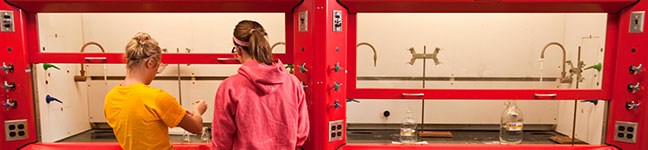
The current organic laboratories provide a much safer environment for our students and include features that enhance the educational experiences for our students. The instructor’s station area and the glass wall board make the communication between faculty and students much easier and the flat bench area with stools, and the additional laboratory space helps students easily perform their experiments and to engage with one another. This is a great advantage compared to previous organic labs, where students had to stand for a period of 3+ hours and perform their experiments in a congested tight space in the labs. Renovation of Organic Chemistry laboratories in 2013 were made possible by the generous support of Cathy and Steve Lacy.