
School of Journalism and Mass Communication
Lead the Conversation
You’re eager to tell stories, find truth, and use your creative powers to captivate an audience. At Drake, you’ll start on that path long before you graduate.
All Majors and Programs
Bulldogs report breaking news, inform public opinion, and craft brand identities—first on campus and then for leading media organizations and agencies.

Undergraduate Programs
All undergraduate programs in the School of Journalism and Mass Communication provide hands-on experiences that will launch your career. Learn to write copy, film video, develop a strategic campaign, and reach your audience.

Graduate Programs
With alumni reporting salary increases of more than 50%, Drake’s 100% online Master of Arts in Communication offers three specialized tracks designed for professionals seeking flexible, high‑impact graduate education.
About the School of Journalism and Mass Communication
With a degree from Drake’s School of Journalism and Mass Communication, you’ll be ready for every change, trend, and platform introduced. Employers know Bulldogs build skills that last, which is why you find our alumni leading projects for a variety of organizations.
.5%
Of SJMC undergrads start their careers or go to grad school within six months of graduation, thanks to abundant internship opportunities in greater Des Moines.
1 of
Private, accelerated journalism and communication programs in the U.S., enabling you to gain hands-on experience from day one and benefit from close faculty mentorship.
th
Place and one of only two private universities to place in the prestigious Hearst Intercollegiate Writing competition.
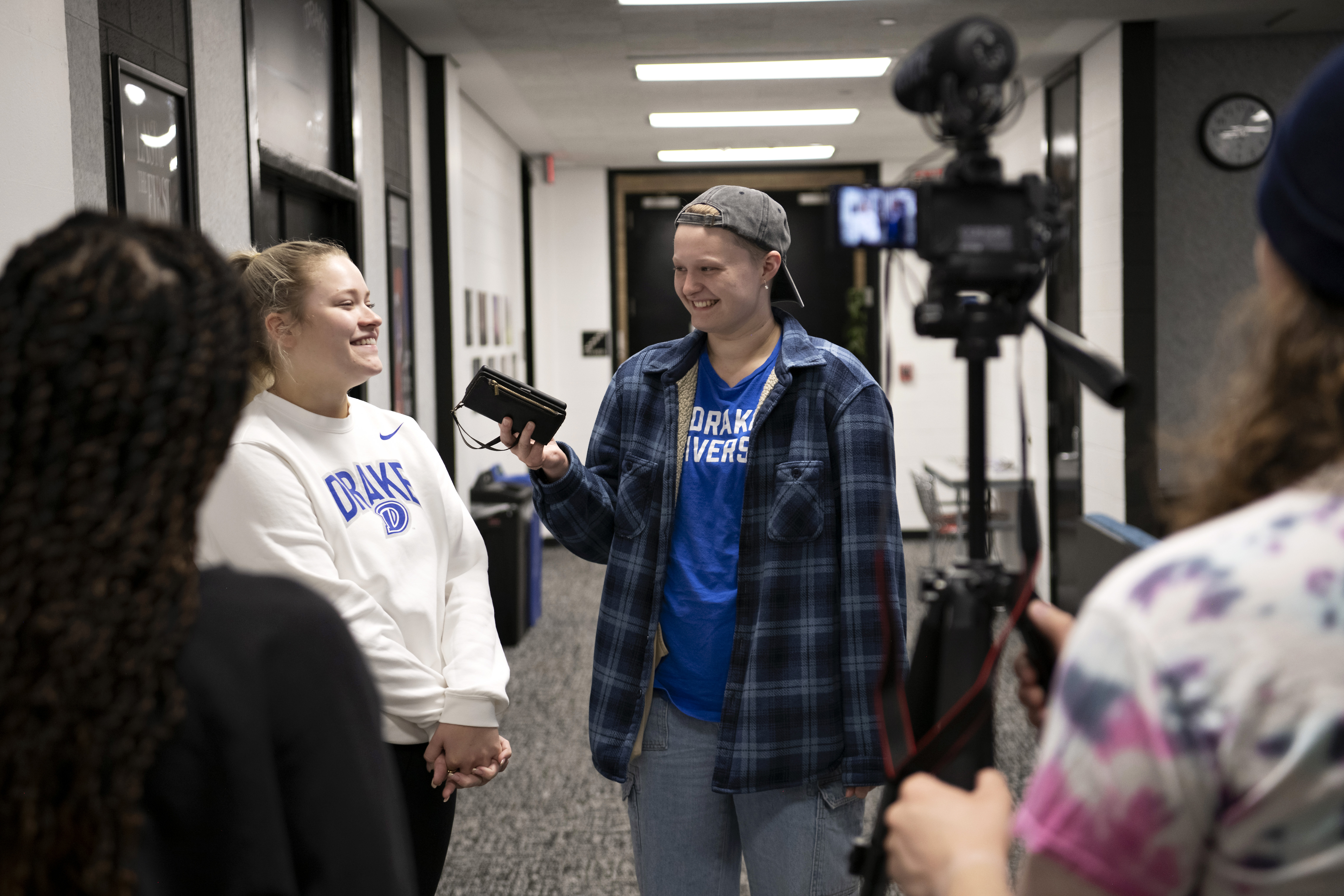
Experiential Learning
If you want to interview a politician, design an advocacy campaign, or create for a real client, why wait? Drake students do those things every day through campus media outlets, real-world internships, and other training opportunities that build their portfolios and professional networks.
Getting Involved
At Drake, student media shines. You could work for one of our award-winning outlets, such as The Times-Delphic or Drake Broadcasting System, Drake Political Review, or Drake Mag. Or find job and internship opportunities through our on-campus institutes or student organizations such as the Ad Club or Public Relations Student Society of America.

Awards
You’ve got some big shoes to fill: Every year, Drake students earn serious accolades for their work. Each year, Bulldogs captured dozens of local, regional, and national honors for categories like writing and reporting, photography, film, public relations, and ad production.
Meet Our Faculty
Each of our 12 full-time journalism and communication faculty aren’t just teachers. They’re also practitioners with years of experience in their fields.


Jennifer Wilson
Peggy Fisher and Larry Stelter Chair, Magazine and Brand Media; Associate Professor, Journalism


Competencies
Whether you’re in journalism, public relations, marketing, or another communications profession, you have lofty responsibilities when it comes to informing the public. Regardless of the major you pursue, you’ll be adept at these foundational principles when you graduate:
- Apply the principles and laws of freedom of speech and press, in a global context, and in the United States.
- Demonstrate an understanding of the multicultural history and role of professionals and institutions in shaping communications.
- Demonstrate culturally proficient communication that empowers those traditionally disenfranchised in society, especially as grounded in race, ethnicity, gender, sexual orientation, and ability, domestically and globally, across communication and media contexts.
- Present images and information effectively and creatively, using appropriate tools and technologies.
- Write correctly and clearly in forms and styles appropriate for the communications professions, audiences, and purposes they serve.
- Demonstrate an understanding of professional ethical principles and work ethically in pursuit of truth, accuracy, fairness, and diversity.
- Apply critical thinking skills in conducting research and evaluating information by methods appropriate to the communications professions in which they work.
- Effectively and correctly apply basic numerical and statistical concepts.
- Critically evaluate their own work and that of others for accuracy and fairness, clarity, appropriate style, and grammatical correctness.
- Apply tools and technologies appropriate for the communications professions in which they work.
- Take ownership of their own academic experience.
- Be engaged with the community: the University, the local community, and professional groups.
- Cope and thrive in the workplace.
News and Events

Take the Next Step
In an age of ever-present media, messaging is more important than ever. Learn how to tell stories that make a difference in Drake’s School of Journalism and Mass Communication.